

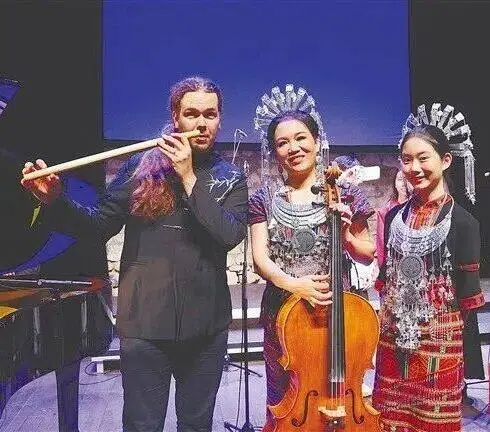

“A group of amazing guides has stepped up to show the world what Hainan’s culture is all about. Thanks to their hard work, these ancient art forms—once tucked away in remote mountain villages—are finally getting the spotlight on the global stage. They’re letting Hainan’s unique heritage shine through international exchanges.”
Title: Hainan’s Bamboo Beats Go Global
“Huang Hailin is on a mission: take the soulful sounds of Hainan’s Li bamboo and wood instruments and share them with the entire world. When he plays, the music is just magical—light, airy, and totally captivating.”
“She’s taken her show to 25 countries. Seriously, she’s played everywhere. And the coolest part? She’s brought that thousand-year-old Li culture back to life on the world stage. It’s not just history anymore; it’s happening now.”
“Huang is a guardian of Li culture. She comes from Wuzhishan City, right in the heart of Hainan, and she’s a master of those traditional bamboo and wood instruments.
But she’s more than just a musician. She’s an artist who’s built a bridge between China and the rest of the world. And she did it all through pure grit and passion.”
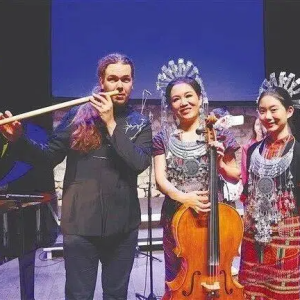
Huang Hailin (center)
“It all started when she was 17. Huang was a dancer in Baoting, a troupe known for Li and Miao culture. One day, she heard Huang Zhao’an—a national-level master—playing the nose flute.
She was hooked instantly. The sound just grabbed her soul. Right then and there, she decided to drop everything and dive headfirst into learning this art.”
“Back then, Huang was obsessed. She poured every ounce of energy into those instruments. Literally every penny of her monthly salary went straight to buying nose flutes. And she lived in that rehearsal hall, often staying until the sun came up.
But here’s the tough part: there were no sheet music books. The Li people passed everything down by ear. So, she became a shadow to the old masters. She’d follow them around, record every note, and just practice like crazy until she got it right.”
“That ‘stubborn’ streak of hers? It paid off big time. That relentless passion became the bedrock for everything she did later, helping her take this culture global.”
“2009 was the big break. Huang took her troupe to Russia. This was the first time Li bamboo and wood music ever hit an international stage.
When she played the nose flute, the sound was so haunting and airy—it just floated through the theater. The crowd? Dead silent. You could hear a pin drop. And then, boom—the whole place just erupted. Thunderous applause that just wouldn’t stop.”
“That’s when it hit her: music really is a universal language. She realized that the world didn’t just tolerate her culture—they actually loved it.
Right then, she knew what she had to do. She made it her mission to share these ‘heavenly sounds’ with as many people as possible. She wanted the whole world to understand Hainan through its music.”
“For the next ten years, Huang basically went on a world tour, hitting 25 countries. Every show felt like a real conversation between cultures.
People were blown away. They couldn’t believe the weird and wonderful techniques—like playing a flute with your nose, or just picking a leaf off a tree and turning it into music. You should have seen their faces; their eyes were wide open with wonder, and they were totally hooked.”
“There’s one moment Huang will never forget. It was 2024, during a roadshow in Italy. After the show, a middle-aged Italian guy walked up to her and just gave her the tightest hug.
Turns out, he was from a long line of craftsmen. He was devastated because his family’s traditional skills were dying out. The younger generation just didn’t want to learn anymore, and seeing that broke his heart. But hearing Huang play gave him hope.”
“Seeing Huang take these traditional Chinese instruments global—and seeing how she kept this ancient craft alive and kicking—hit him right in the feels.
It was that cross-border connection. Two total strangers, brought together by the sheer power of culture. It was a moment he’ll never forget.”
“Huang admitted, ‘When I saw his tears, I finally realized just how heavy this burden is.’
She wasn’t just playing songs or showing off instruments anymore. She was carrying the hope that these ancient traditions wouldn’t die out. She had to pass them on to the next generation.”
“Then in 2016, she made a big move. She rounded up a crew and launched ‘Voice of Wuzhishan’—the very first Li bamboo and wood instrument orchestra in Hainan.
By mixing traditional instruments like the nose flute, zhuoba, and dingdong, she opened doors for everyone. Now, people could actually learn these ancient skills through real performances and proper classes.”
“For Huang, spreading culture is a two-way street: she takes it out there with guts, and welcomes people in with open arms.
Take Polina, for example. She’s a Russian host at the Hainan International Media Center. She fell in love with the nose flute and basically begged Huang to teach her. Huang took her under her wing, helping her nail the technique, but also showing her the soul of this Li art form.”
“Huang didn’t stop there. She dropped a solo nose flute album. She’s constantly tweaking her technique and messing around with new arrangements.
Her goal? Keep that classic, traditional vibe—but make it sound fresh and cool for modern ears. It’s all about bridging the gap between the ancient and the new.”
“Huang puts it simply: ‘I want to be the bridge. I’m here to connect the heartbeat of Wuzhishan to the rest of the world. My goal is to make sure the sounds of Li bamboo and wood instruments are heard in every corner of the globe.’ She says it with quiet confidence.”
0 Comment